Villagers rescue Ruby from a pit
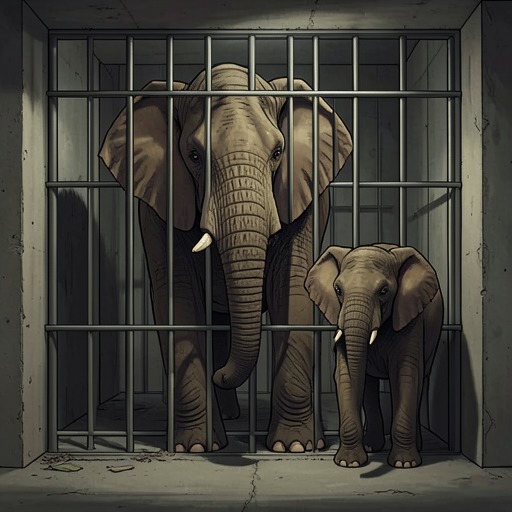
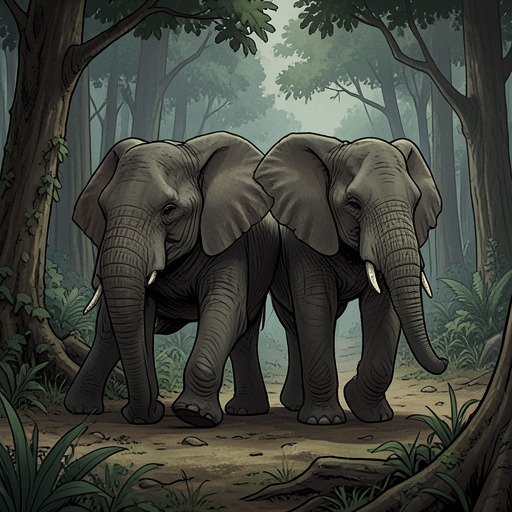
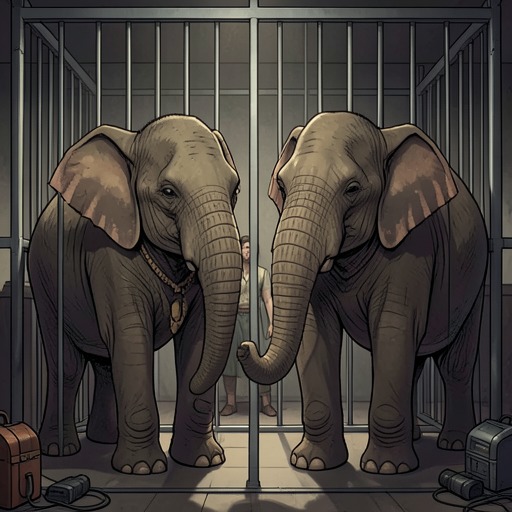
The One and Only IvanRuby’s account of falling into a water-filled pit and being rescued by a village offers a crucial counterexample to the idea that humans act only as captors. Told as a story within the larger narrative, the episode turns on Ruby’s distinction between people who harm animals and people who help them: the villagers pull her out and lead her back to her family, even though other humans later send her into captivity.
The Story Ruby Tells
Ruby begins her story when she is impatient and proposes telling a true account about herself. She says that she fell into a large hole dug by humans. The tale is addressed to Ivan, while Bob comes over to listen from beside the window and remarks on his interest in digging stories. This casual, companionable start gives way to a memory of danger, then to an account that challenges Bob’s expectations.
Ruby places the pit near a village and says she does not know why people had dug it. She and her family had been looking for food; after wandering away and getting lost, she went too close to the village and fell in. The pit was large and full of water. Ruby describes the water as reaching her neck and says she was certain she would die. Her gestures as she tells the story—the trunk making a circle in the air to indicate the hole—give Ivan and Bob a concrete measure of its scale without changing the story into an abstract lesson.
The Rescue
Bob assumes that Ruby’s presence at the mall must mean the people who found her captured her, put her in a box, and shipped her away. He compares this supposed fate to Stella’s and launches into a denunciation of humans. His explanation is plausible within the animals’ experience of confinement, but it is not what happened in the pit. Ruby interrupts to correct him: when the villagers saw her trapped, they fetched ropes and made loops around her neck and tummy so they could pull her out.
The rescue is collective rather than the work of a named hero. Ruby emphasizes that the whole village took part, including small children and older residents, and that they kept pulling until she was free. She stops while recounting the effort; Ivan notices that her lashes are wet and understands that she is remembering the distress of that day. She then finishes by saying that the villagers saved her. The pause makes the rescue more than a brisk anecdote: the recollection carries the fear of being trapped as well as the relief of being helped.
After Ruby is out, the villagers cheer and the children feed her fruit. They then lead her back toward her family, a search that takes the rest of the day. Bob remains doubtful, asking how Ruby could be at the mall if humans were so kind. Ruby does not deny the contradiction. She says that harmful humans killed her family and sent her to the mall, while the people at the pit were good. The rescue therefore does not erase her later suffering or make her trust all humans; it preserves a distinction between different human actions and the people responsible for them.
Human Kindness and Captivity
The exchange changes the terms of the conversation between the animals. Bob treats human beings as a single, incomprehensible group, but Ruby’s memory refuses that simplification. Her account gives human kindness specific forms: ropes used to lift her, a village pulling together, fruit offered after she is safe, and a day spent helping her find her family. The helpful actions do not undo the cruelty she also names. Instead, her testimony holds both truths together, while Bob admits that he cannot make sense of humans and Ivan acknowledges that he is not alone in that difficulty.
The setting in which Ruby tells the story sharpens its contrast. Ivan lives in a mall enclosure he calls his domain, and the nearby Glass Wall separates the animals from visitors who press their hands against it. In that world, human presence often means observation and confinement. Ruby’s memory offers another possibility: people can enter an animal’s danger not to take possession of her but to bring her back to her family. The difference depends on what people do, not simply on whether they are human.
Place in the Larger Narrative
The book repeatedly presents animal spaces as both shelters and restrictions. Later, a giant box is moved against Ivan’s open doorway, making the apparent route out lead into another human-made container. At the zoo, he sees a high white wall built to keep animals in and others out, and recognizes that the new setting is still a cage. These later details do not alter the events of Ruby’s rescue; they make its contrast more precise. The villagers’ ropes enable Ruby to leave the pit, while enclosures and transport boxes restrict movement elsewhere in the animals’ lives.
Because the episode reaches the reader through Ruby’s recollection, it also gives her authority over the meaning of her own past. Bob supplies an assumption based on captivity, but Ruby corrects it with the details of what happened and with her distinction between the people who saved her and those who harmed her. The episode’s decisive significance lies in that correction: it neither excuses human cruelty nor permits it to stand for every human act. Ruby remembers a rescue in which an entire village helped her survive and return to her family.